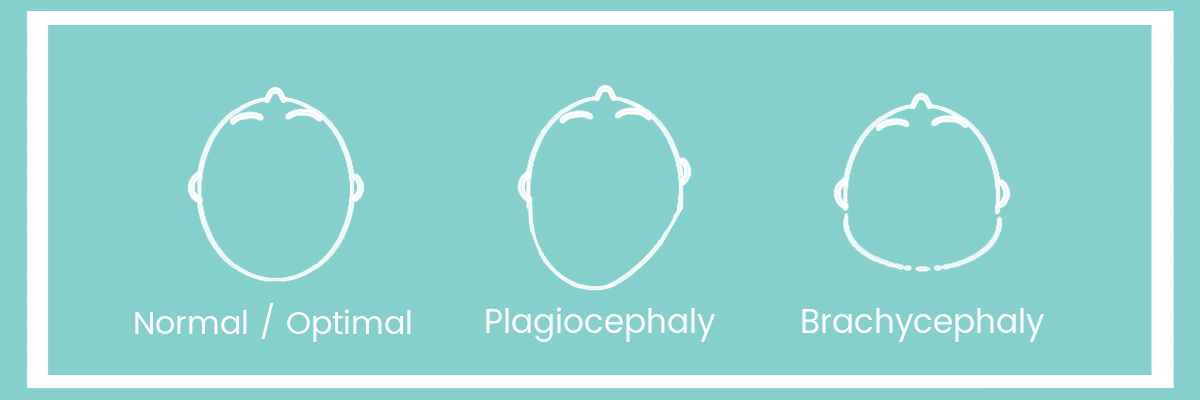
When a child is born, they have seven separate bones that make up the skull. These are all held in place with fibrous tissue which allows the skull to compress and change shape especially during birth. These bones do not begin to ‘fuse’ until around 12-18 months of age. During this time, if a particular area of the skull is always under pressure the cranial bones may move to accommodate.
For example, if a child can not turn their head to one side, they tend to sleep with their head facing the same way all the time and they are not developing muscles to support the head and neck equally, a flat spot may develop. This is called Plagiocephaly if it affects one side brachycephaly if it is symmetrical across the back. There also appears to have been an increase in plagiocephaly with the encouraging of back sleeping for preventing SIDS. With so much time spent on their backs, it is important to encourage different positions as much as possible during waking hours.
Why does it matter? Plagiocephaly has been significantly associated with delays in learning - especially motor learning and co-ordination.
There are just a few of the signs to look for that may suggest a child is more likely to develop a flat spot.
They struggle to breast feed on one side or favour one breast in particular
A bald patch is developing
They strongly dislike tummy time
They sleep with their head turned to the same side all the time
They appear to be “right handed” or “left handed” early as they are not using one arm or leg as much as the other side
If you are unsure - see how far your baby will turn their head either way over a couple of days. Place toys, make noises, talk to them from the side you have noticed they are not turning to and see how far they turn their head. This is a good test but also a good way to start encouraging the muscles to work better on that side. ‘
Here are some things you can do if your child isn’t turning fully in both directions to encourage better range of motion.
Use a wrist rattle on the hand they are not turning toward
Place toys, make noises and talk to them from the side they are not turning towards
Turn them 180 degrees in their bed as they may be turning toward (or away from) noise, light, movement or activity
Do tummy time more often but for shorter stints. From 4 weeks of age, tummy time should be the first position you put them in whenever they are “down” but not sleeping. When in tummy time position - aim to get their hands underneath their shoulders to encourage them to push up.
Ball rolling over a Swiss ball (also called a gym ball)
When detected early, changes are often achieved easier and more quickly. If after 2 weeks, your child is still struggling - please book your child in or give me a call. I’d love to help.